How Attention Autism is Transforming Connection at Ochil Tower School
At Ochil Tower School, supporting communication, connection, and meaningful engagement is our core value. One approach that reflects this is an approach called Attention Autism.
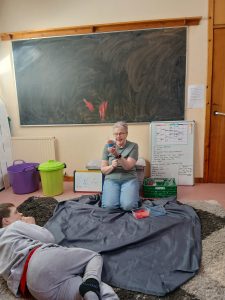
To better understand this practice, we spoke with Ochil Tower School Teaching Assistant Jackie Hird, who delivers Attention Autism sessions, often known as “Bucket Time”, to our children and young people. Studies suggest that this practice can support communication, concentration, and independence for autistic children and young people: https://augmentive.io/blog/attention-autism-benefits
What is Attention Autism?
Attention Autism is an approach created by Gina Davies, a Specialist Speech and Language Therapist. The programme aims to support autistic children and young people in developing their engagement, attention, and communication skills. As Jackie explains: “It creates opportunities for young people to have shared social experiences in a fun and engaging way.” Rather than directing attention, Attention Autism encourages learners to choose to engage.
Engagement First, Learning Follows
Jackie explains that the primary goal of the program is to support social interaction and language development by creating shared experiences. Unlike traditional settings where children might be directed to focus, Jackie explains that Attention Autism encourages them to choose to engage. “We want to deliver something that young people are drawn to without being directed,” and that when the children choose the activity, they are choosing to have a shared social experience.
The Power of “Wow”
A central element of Attention Autism is creating moments that feel exciting and memorable. Jackie explains it as having to be wow. Activities are designed to be:
- Highly visual
- Sensory-rich
- Simple yet captivating
Equally important is how these sessions are delivered. Their success relies heavily on the energy of the person running the session. Jackie believes the leader must be fully present. “You have to deliver it body and soul, it’s got to be authentic,” she shares. Jackie warns that the biggest challenge is maintaining this energy, noting, “If I’m not fully present and engaged, it won’t work”.
Structure Behind the Play
At first glance, a session might look like simple play, but Jackie stresses there is a rationale and clear structure behind every movement. The sessions follow specific rules: learners sit together in a shared space, materials are kept out of reach to build anticipation, and adults model behavior rather than giving verbal commands.
“It’s not about telling the children to look, it’s about showing them,” Jackie explains. This structure creates the consistency and safety the children need to explore new skills, such as turn-taking, shared attention, and increased tolerance of group settings
Building Meaningful Connection
One of the most powerful outcomes of Attention Autism is the trust it builds between children and young people and the Ochil Tower Education team. For Fraser, one of the young people at the school, the progress he has made through this practice is very clear. When Fraser first began his sessions, his transition into group learning was difficult. He often struggled with Stage One (the bucket session) and was unable to sit still or engage for more than three to five minutes. Through consistent work by Jackie, she has supported Fraser to build his tolerance and focus. He has now progressed through stage two and stage three, and Jackie has observed that these skills are now transferring into his other school activities, showing that Attention Autism has a lasting impact.
Half the Battle
While widely used in specialist settings, Jackie believes Attention Autism can benefit any learner facing communication barriers. It provides a space where students feel engaged, confident, and connected. Ultimately, the approach reminds us that learning begins with a desire to be present. As Jackie puts it, “When they want to be there… that’s half the battle.”